By using this site, you agree to the Privacy Policy and Terms of Use.
Accept
Health Works CollectiveHealth Works CollectiveHealth Works Collective
  • Health
    • Mental Health
  • Policy and Law
    • Global Healthcare
    • Medical Ethics
  • Medical Innovations
  • News
  • Wellness
  • Tech
Search
© 2023 HealthWorks Collective. All Rights Reserved.
Reading: Consumers Prefer Marketing Collateral by Post to Email
Share
Notification Show More
Font ResizerAa
Health Works CollectiveHealth Works Collective
Font ResizerAa
Search
Follow US
  • About
  • Contact
  • Privacy
© 2023 HealthWorks Collective. All Rights Reserved.
Health Works Collective > Business > Consumers Prefer Marketing Collateral by Post to Email
Business

Consumers Prefer Marketing Collateral by Post to Email

Nicola Ziady
Nicola Ziady
Share
3 Min Read
It is no surprise that the most trusted information sources were doctors and nurses and other healthcare providers. Newspapers, corporate websites and online search engines comprised the next tier of trust, getting the vote from about 1 in 5 respondents.
SHARE

Overall, trust in brochures, flyers and direct mail is fairly low, but still beats out email.

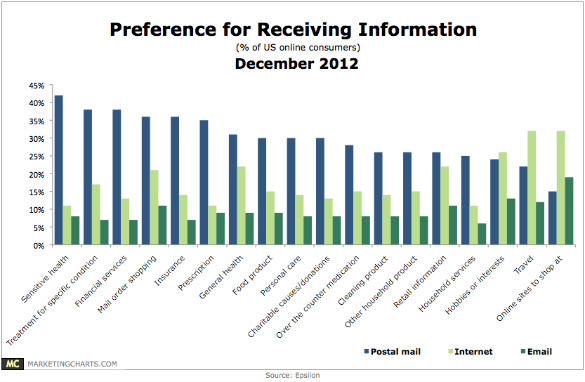
16% of US respondents to an Epsilon report gave a top score to traditional print pieces, compared to 12% for email. That landed email at the bottom of the preference list.

When breaking down the responses by gender, women came out as more trusting than men on both counts: 19% compared to 13% for brochures, flyers, and direct mail; 14% compared to 10% for email.

Overall, trust in brochures, flyers and direct mail is fairly low, but still beats out email.

More Read

ACO or Bundled Payments?
ACOs vs. Bundled Payments: Can Either Save Healthcare?
Who’s Who of Health Care Join Forces for SMART Technology
Physician Online Reputations: What Role for Hospitals?
Health Insurance Industry Has Worst Customer Service – Survey Says
Social Recruiting Activity Report

16% of US respondents to an Epsilon report gave a top score to traditional print pieces, compared to 12% for email. That landed email at the bottom of the preference list.

When breaking down the responses by gender, women came out as more trusting than men on both counts: 19% compared to 13% for brochures, flyers, and direct mail; 14% compared to 10% for email.

The biggest finding relates to sensitive health information:
42% want to receive personal health information by postal mail, compared to 11% over the internet and 8% by email. Privacy concerns no doubt play a role.
It is no surprise that the most trusted information sources were doctors and nurses and other healthcare providers. Newspapers, corporate websites and online search engines comprised the next tier of trust, getting the vote from about 1 in 5 respondents.

It is no surprise that the most trusted information sources were doctors and nurses and other healthcare providers. Newspapers, corporate websites and online search engines comprised the next tier of trust, getting the vote from about 1 in 5 respondents.

Key findings from the study include ::

  • 42% of U.S. consumers said direct mail is the preferred channel to receive sensitive health information
  • 3% of U.S. consumers use mobile QR codes
  • U.S. tablet users are 50% more likely to prefer receiving information via email compared to those without smartphones
  • 73% said they receive a lot of emails that they simply do not open
  • 70% said they have received more emails in the past year than the year before
  • 62% said they enjoy checking the mailbox for postal mail
  • 51% of U.S. consumers consumers said they pay more attention to postal mail than email
  • 73% of U.S. consumers said they prefer direct mail for brand communications because they can read the information at their convenience

About the source :: The Epsilon report on channel preferences for the receipt of marketing information is based on the responses of 1,991 U.S. consumers to an online survey conducted in June 2012. Read the full Epsilon report.


 
TAGGED:healthcare marketing
Share This Article
Facebook Copy Link Print
Share

Stay Connected

1.5kFollowersLike
4.5kFollowersFollow
2.8kFollowersPin
136kSubscribersSubscribe

Latest News

post-surgical recovery
Your Guide To Key Milestones In At Home Post-Surgical Recovery
Health Infographics
December 14, 2025
Dehydration Poses Serious Risks For Older Adults
Why Dehydration Poses Serious Risks For Older Adults
Infographics Senior Care
December 14, 2025
care settings
Hidden Risks In Care Settings: Who Faces The Greatest Threat From Healthcare-Associated Infections
Global Healthcare Health care Infographics
December 14, 2025
Medical Appointment
From Scheduling To Follow-Up: The Full Lifecycle Of A Medical Appointment
Infographics Medical Education Policy & Law
December 14, 2025

You Might also Like

Hospital AdministrationMedical EthicsPolicy & LawWellness

How Healthcare Professionals Can Keep on Top of Stress at Work

September 24, 2018
medical technology
BusinessFinanceMedical DevicesMedical InnovationsTechnology

Ideal Medtech Products

May 10, 2014

Bigger Health System, More Room to Tinker?

January 10, 2014

The Fallacy of Patient Engagement

April 10, 2015
Subscribe
Subscribe to our newsletter to get our newest articles instantly!
Follow US
© 2008-2025 HealthWorks Collective. All Rights Reserved.
  • About
  • Contact
  • Privacy
Welcome Back!

Sign in to your account

Username or Email Address
Password

Lost your password?