This is the fourth in a series of posts about a concept I’m really excited about: Making Health Addictive.
This is the fourth in a series of posts about a concept I’m really excited about: Making Health Addictive. In addition to a framing post, I also recently posted on two of three strategies, “Make it About Life” and “Make it Personal.” Making health addictive is really about harnessing the power of our fascination with mobile devices, particularly smartphones. We check these devices up to 150 times per day. What if we put a personalized, relevant, motivational and unobtrusive message in front of you some of those times? Could we induce permanent behavior change? I am searching for examples of these customized mobile, personalized messages and any resulting behavior change, so if you know of any, please let me know. Today I’m writing about strategy #3:
Reinforce Social Connections
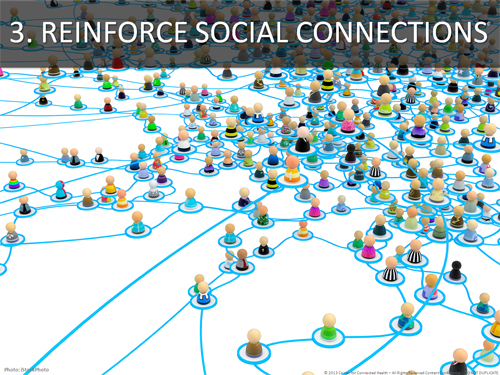
For some, the power of social connections is self-evident. Those of you in this category probably spend lots of time on Facebook and make sure you keep in touch with your close friends and family on a daily basis. But the impact of social connections goes much deeper than what is obvious on the surface. To my knowledge, the first large scale lesson on this was popularized by Nicholas Christakis and James Fowler in their book Connected. If you haven’t read it, I advise it. Very enlightening line of research. Health, obesity and chronic illness all have predictably spread through social networks even when individuals are not in physical contact.
Sharing health information in a social context illustrates the power of two powerful psychological phenomena I’ve referred to before: Social Desirability Bias and the closely related Sentinel Effect. Both of these constructs remind us how powerful the effect of being watched is. When we display certain aspects of our lives, we are more likely to want to emphasize the positive and minimize the negative. This is what leads to the constant complaining that people’s Facebook pages are not a reflection of reality but of the reality we’d like.
Likewise when it comes to our health, we go out of our way to emphasize the positive and might even tend to overestimate the positive at times, if left to our own devices. When reporting is anchored by an objective data source such as an activity tracker or a blood pressure monitor, we realize that we cannot select only the data we like, so we compensate by improving the behaviors that are reflected in those objective data.
In fact, according to a recent Harris Interactive survey conducted on behalf of Wellocracy, our latest project to reach consumers with information and guidance on health tracking, the majority of Americans (68%) report that encouragement from family and friends is important for them to achieve health goals.
The sentinel effect is a more extreme idea, illustrating how people respond when they know they are being observed and evaluated. If the evaluator is your doctor, the tendency to want to improve health behavior goes up dramatically.
These days almost every mobile experience has the option to share as an integrated component. As we think about making health addictive, and how we can slip unobtrusive, personalized, motivational messages into your life as you constantly check your mobile device, making the experience social will have a big impact on adherence and success. We have to make the experience compelling enough, however, that you will want to share with others.
To this point, I’ve talked about three strategies, “Make it About Life,” “Make it Personal.” and now, “Reinforce Social Connections.” Next I’ll talk about three tactics: “Employ Subliminal Messaging,” “Use Unpredictable Rewards” and “Use the Sentinel Effect.”