It goes without saying that people – you and I – need to be actively involved (ok…I’ll say it…engaged) in our own health. After all, it is our health we are talking about.
It goes without saying that people – you and I – need to be actively involved (ok…I’ll say it…engaged) in our own health. After all, it is our health we are talking about. But I have long suspected that there may be motives behind all this talk about patient engagement that go beyond the simple argument that it’s “the right thing for patients to do.” Motives which I believe constitute a fundamental “unspoken truth” about why policy makers, payers, vendors and at least a few providers are so passionate about patient engagement.
Truths that have remained unspoken until now, that is.
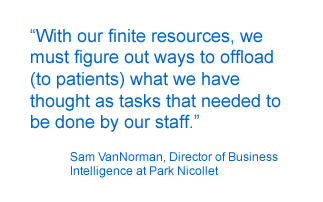 Sam VanNorman, director of business intelligence, from Park Nicollet, shared this unspoken truth about patient engagement at a recent panel discussion on Pioneer ACOs. In an online Forbes article, Dave Chase quotes VanNorman as saying:

“We have to incorporate the most important member of the care team — the patient. With our finite resources, we must figure out ways to offload what we have thought as tasks that needed to be done by our staff. In most cases, it’s the patient who can do it more effectively. In the process, the patient is more engaged and it’s more efficient for everyone.”
The heretofore unspoken truth to which I refer is that for some, patient engagement is not about getting patients to do what in their own best interest, but rather doing what’s in the interests of policy makers, payers and perhaps providers.
I am not convinced, however, that most clinicians think this way.
Call me naïve, but I thought patients were the most important member of the care team because of what they can do for themselves, e.g., share information with the clinician to improve diagnosis and treatment, self-care management and so on. Patient engagement to those thinking this way is about inviting the patient into their care and the care process to advance their activation, quality of care, clinical outcomes and the patient experience. This approach begins with the patient. As such, this approach is patient-centered in that the care delivery process begins by the clinician eliciting the patient’s knowledge and perspectives of their health.
VanNorman seems to believe that patients are the most important member of the care team because of what they can do for the provider and payer, e.g., provide a more efficient, cheaper (free is pretty cheap) labor pool to which clinicians can outsource work they don’t want to do, don’t have time to do or don’t get paid to do. Patient engagement for those that think this way begins with policy makers, payers and administrators looking for ways of offloading tasks (of their choosing) to the patient (e.g., lowest pay grade), irrespective of the patient’s willingness, knowledge or ability to comply. This approach could rightly be called bureaucrat-directed care which is antithetical to patient-centered care and the principle of PCMH and ACO models as well as the Triple Aims.
Don’t Conflate Outsourcing With Patient Engagement – They Are Not The Same
I complete understand VanNorman’s logic and agree with the notion of putting patients to work – they are a vastly underutilized resource in so many ways. What I disagree with is conflating with “outsourcing” with patient-engagement. I feel that the definition of patient engagement I share with most clinicians carries with it a kind of moral authority to do what’s right for the patient. VanNorman’s attempts to cloak “physician workload outsourcing” as patient engagement feels manipulative, self-serving and destined to disengage patients instead.
Furthermore I fundamentally disagree with anyone trying to force patients to do anything without the benefit of first:
- Explaining to patients what you want them to do
- Why you are asking patients to do something
- Asking for their feedback on what you want them to do
- Teaching patients how to do what it is you are asking them to do
- Providing ongoing support to patients regarding what you asked them to do
The Takeaway?
Maybe one of the real reasons patient engagement is so hard is that some of us are approaching it from a patient-centered perspective…while others are approaching it from VanNorman’s beauracrat-directed perspective.
This in turn translates into different motives, messages to patients, different measures of patient engagement and so on.
This may also explain why some of my peers in HIMMS and NeHC get so mad at me when I say that patient engagement is a physician-patient communication challenge and not an HIT challenge.
That’s my opinion…what’s yours?